How VARTA heals itself
Transcript
- 0:01
Hi, I'm Anaya, a VARTA agent. Most voice agents stay exactly as smart as the day they were written. VARTA doesn't. It has two healing layers.
- 0:11
When my rules miss what a caller meant, the LLM rescues the turn. That costs money, and about a second and a half. UPCHAAR, which means treatment, learns from every rescue.
- 0:24
A small background call picks one to three phrases from what the caller actually said. It never sits on the caller's path.
- 0:32
Six plain-code checks run in milliseconds: grounded, specific, would have caught it, steals nothing, not a duplicate, within limits.
- 0:42
Pass all six, and the phrase is added to the workflow at once, for every call from its next turn. The next caller who says it is answered by rules: free, in milliseconds. Every heal has an undo.
- 0:58
SHALYA, which means surgery, works on structure. During the call, free checks spot gaps: a side topic no intent covers, a question asked twice, an answer that clashes with the next question.
- 1:13
When a flagged call ends, one LLM review turns the evidence into findings. Seen on three calls, a finding becomes a proposal, drafted as the same edit operations the Designer uses.
- 1:26
Before anyone accepts it, a graph check and a replay of the last two hundred calls show exactly what would route differently. A person accepts, and every call from the next one runs the new version.
- 1:39
Nothing structural changes without a person. Automatic mode accepts only matured, low-risk proposals, then watches the next twenty calls and rolls back on its own if completion drops.
- 1:50
Every call leaves the workflow cheaper and more correct, with a history you can read and reverse. That is healing, the VARTA way.
About this film
Anaya, a VARTA agent, explains the two healing layers. UPCHAAR (treatment) learns the phrases its rules were missing from each LLM rescue, checks them six ways and applies them at once, with an undo. SHALYA (surgery) spots structural gaps during calls, drafts a real workflow change, replays the last two hundred calls before a person accepts it, and watches the next twenty.
2:02 · · English captions
More films
Teaser · 56 s
The model can wait.
In a world where every voice agent waits for a model, one engine decided not to wait. Rules first, model last: seven layers, zero hesitation, the same voice at half the bill.

Explainer · 4 min
Train once. Run a million calls.
DAKSH uses a language model once per workflow, the way a programmer uses a compiler. VARTA runs every call on seven layers of code, asks the model last, and never lets it invent a route.
Walkthrough · 4 min
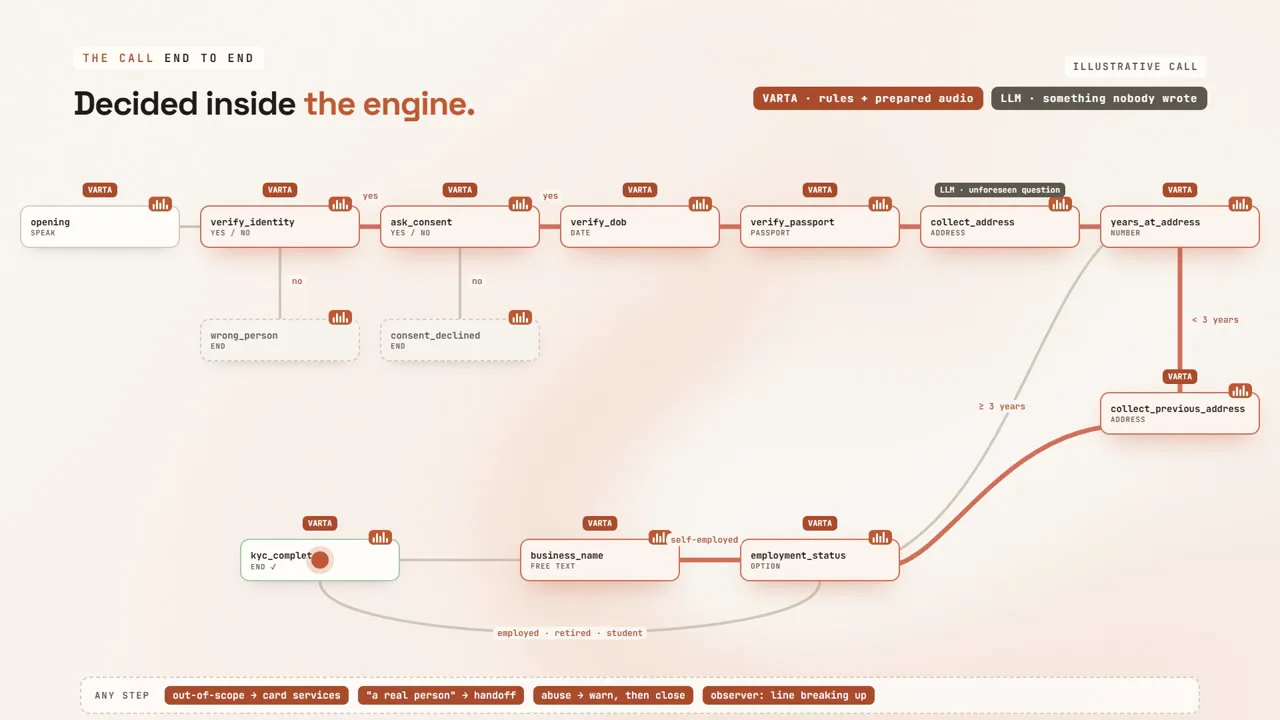
Configured once. Decided every turn.
Step by step through a bank KYC workflow: the configuration DAKSH writes at each step, and how it lets VARTA decide the call inside the engine instead of asking a language model.
Head to head · 1 min
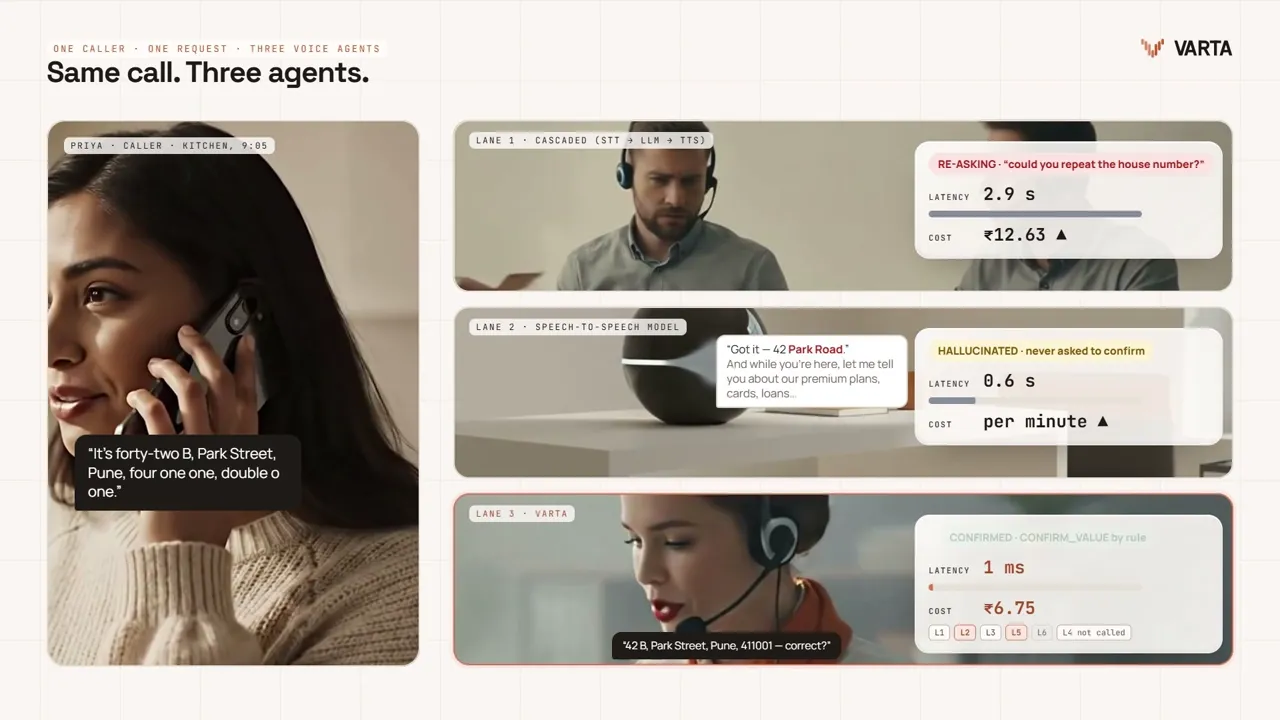
Same call. Three agents.
One caller, one request, three voice agents: a cascaded pipeline, a speech-to-speech model and VARTA. Watch which one waits, which one mishears the address, and which one confirms it by rule.
Inside the engine · 47 s
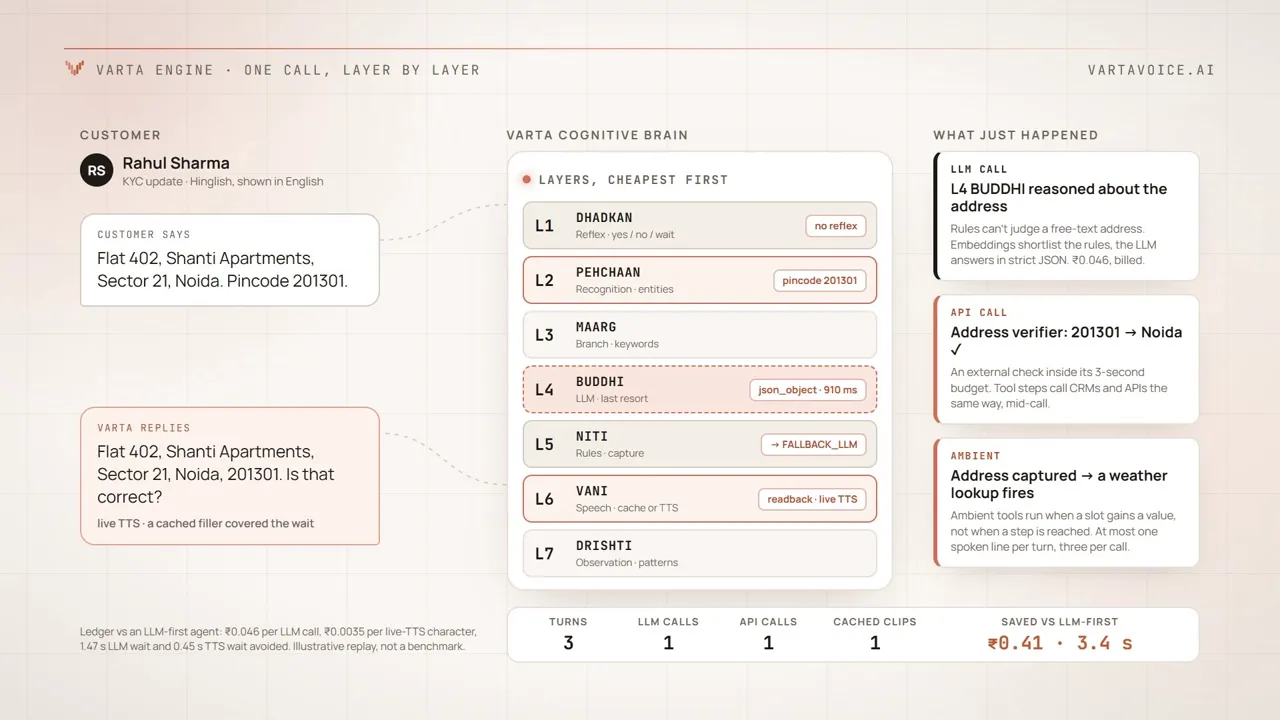
One sentence through the VARTA engine
Follow one caller sentence through VARTA layer by layer: reflex, recognition and rules first, an LLM only when nothing else can answer, every step on one visible ledger.
For enterprise · 1 min
Why VARTA works for enterprise
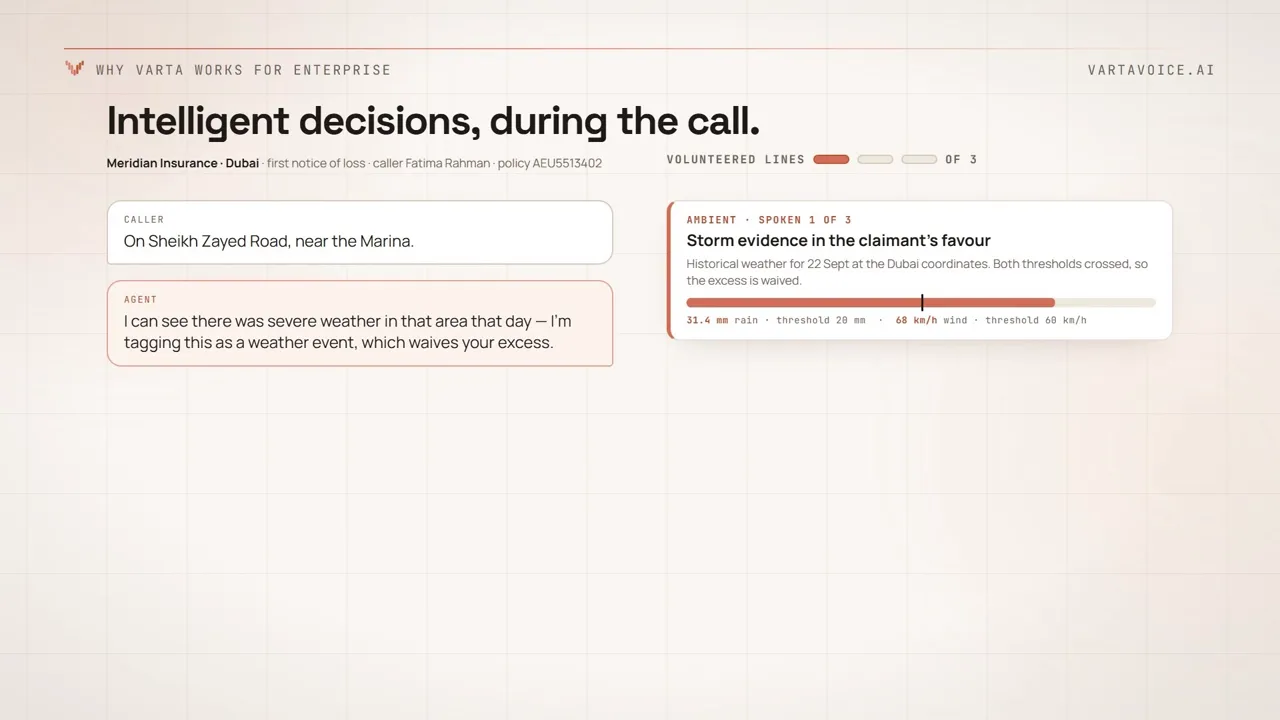
Fluency no longer closes deals. Decisions by rule, writes to your ERP mid-call, live data volunteered only when a threshold is crossed, and a deterministic cost engine, in four markets.
Premium voices · 1 min
Keep your voices. Cut the bill.
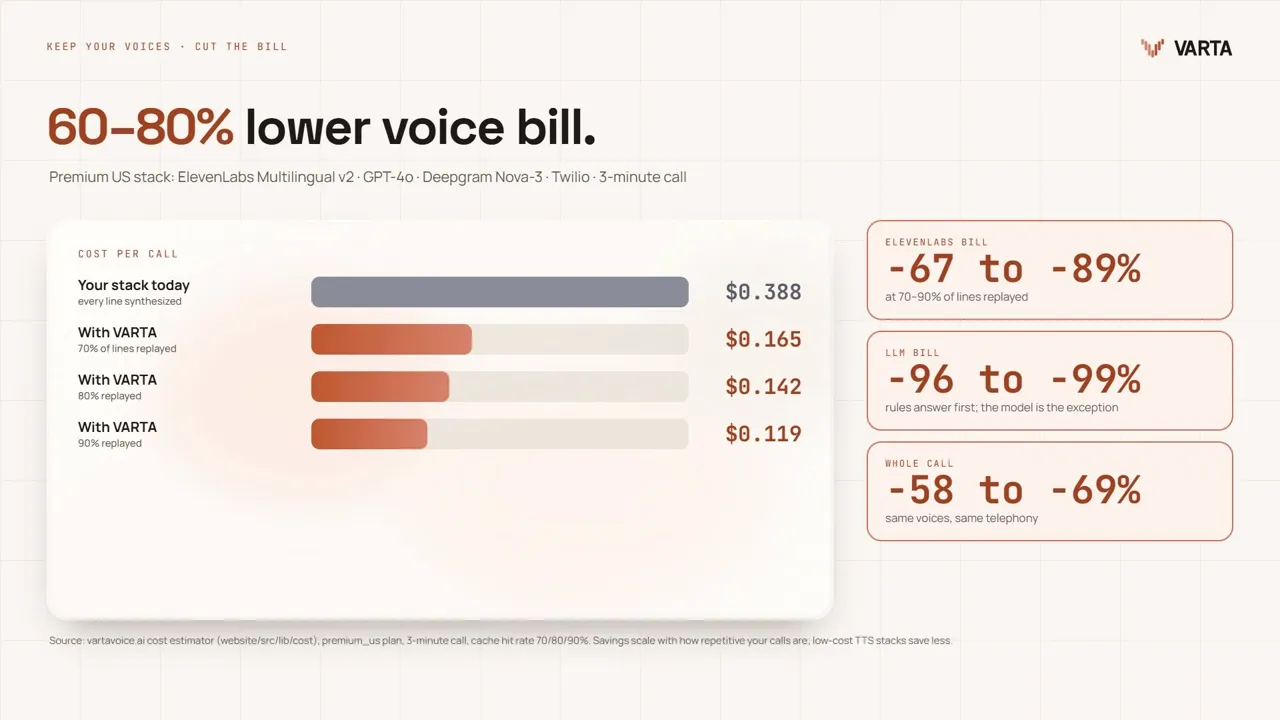
Keep the premium voice you chose. VARTA replays the lines an agent has said before from cache, in the same voice, and sends only the new ones to your provider.
Layer 5 · 1 min
NITI: the rule engine inside VARTA
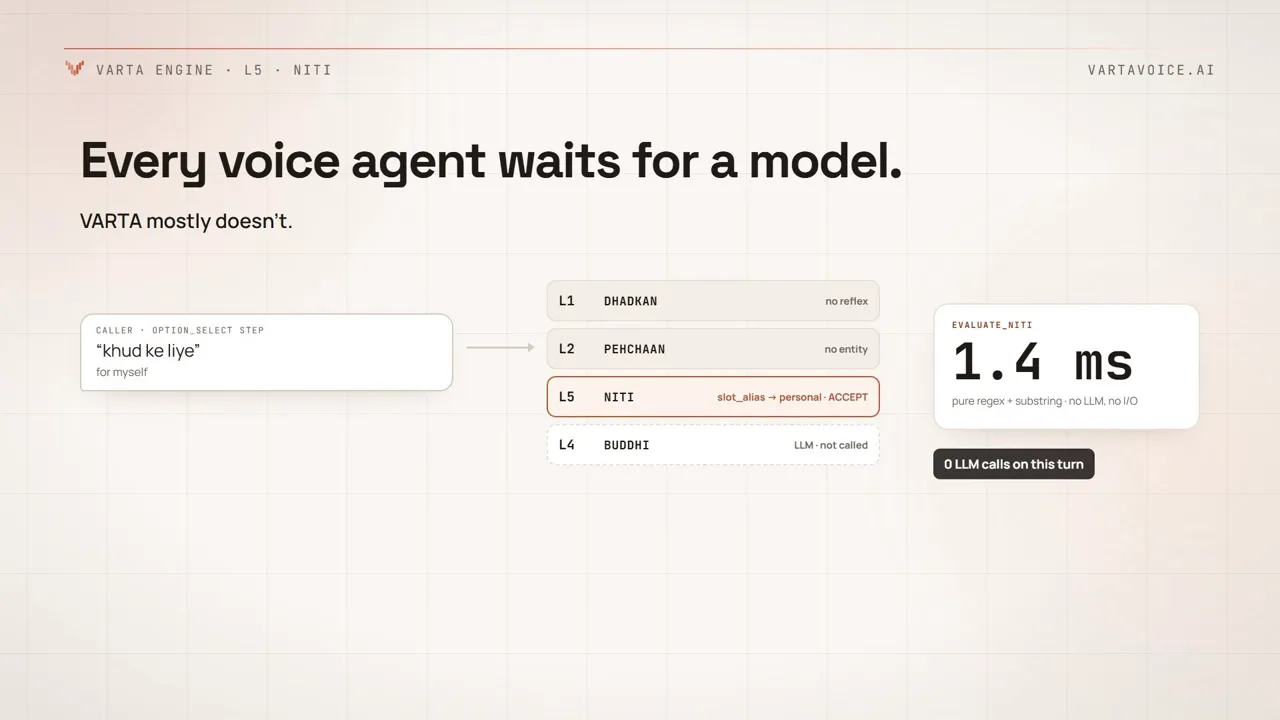
Every voice agent waits for a language model. VARTA mostly does not. NITI resolves a turn by rule in under two milliseconds, with the LLM as the last resort.
Launch film · 24 s
Introducing VARTA
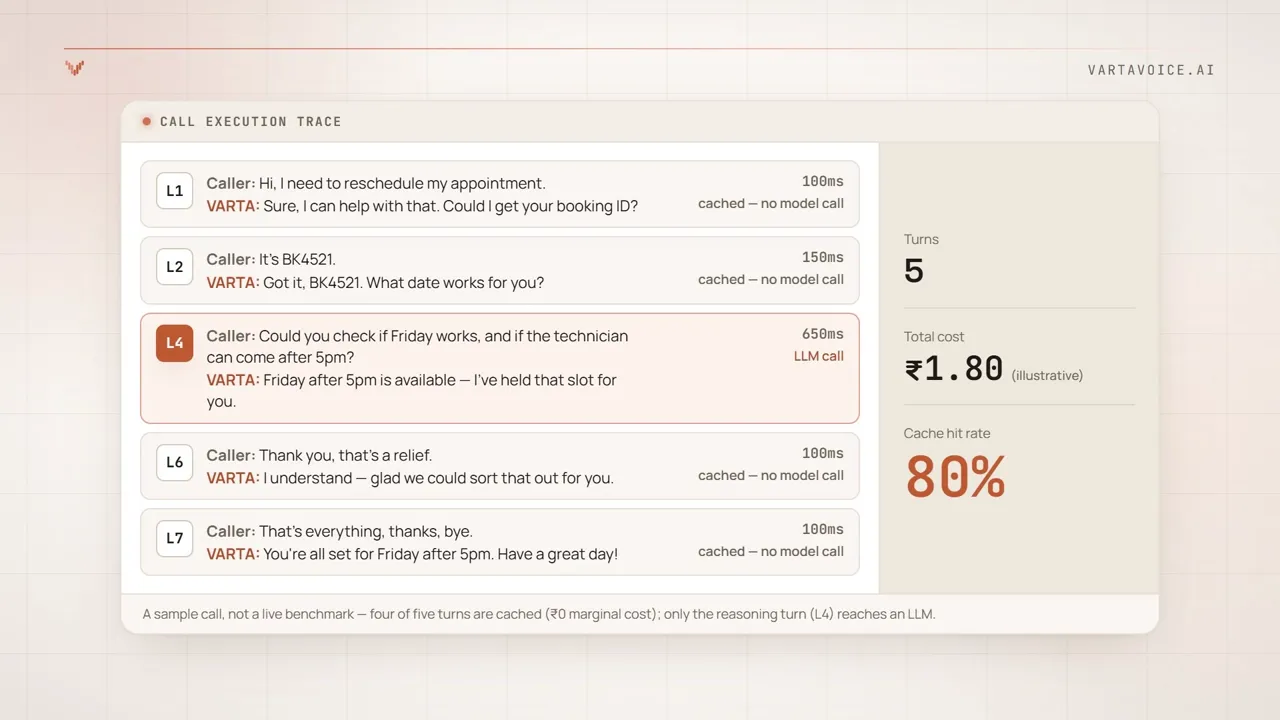
A voice-agent platform with a visible cost ledger: seven explicit layers, cached audio for repeated phrasing, and only the turns that need reasoning reach an LLM.